 Smart Jelly
How Smart Jelly remembers
Every feature in Smart Jelly reads from one memory. Here is what it keeps, how it stays accurate, and where it lives.
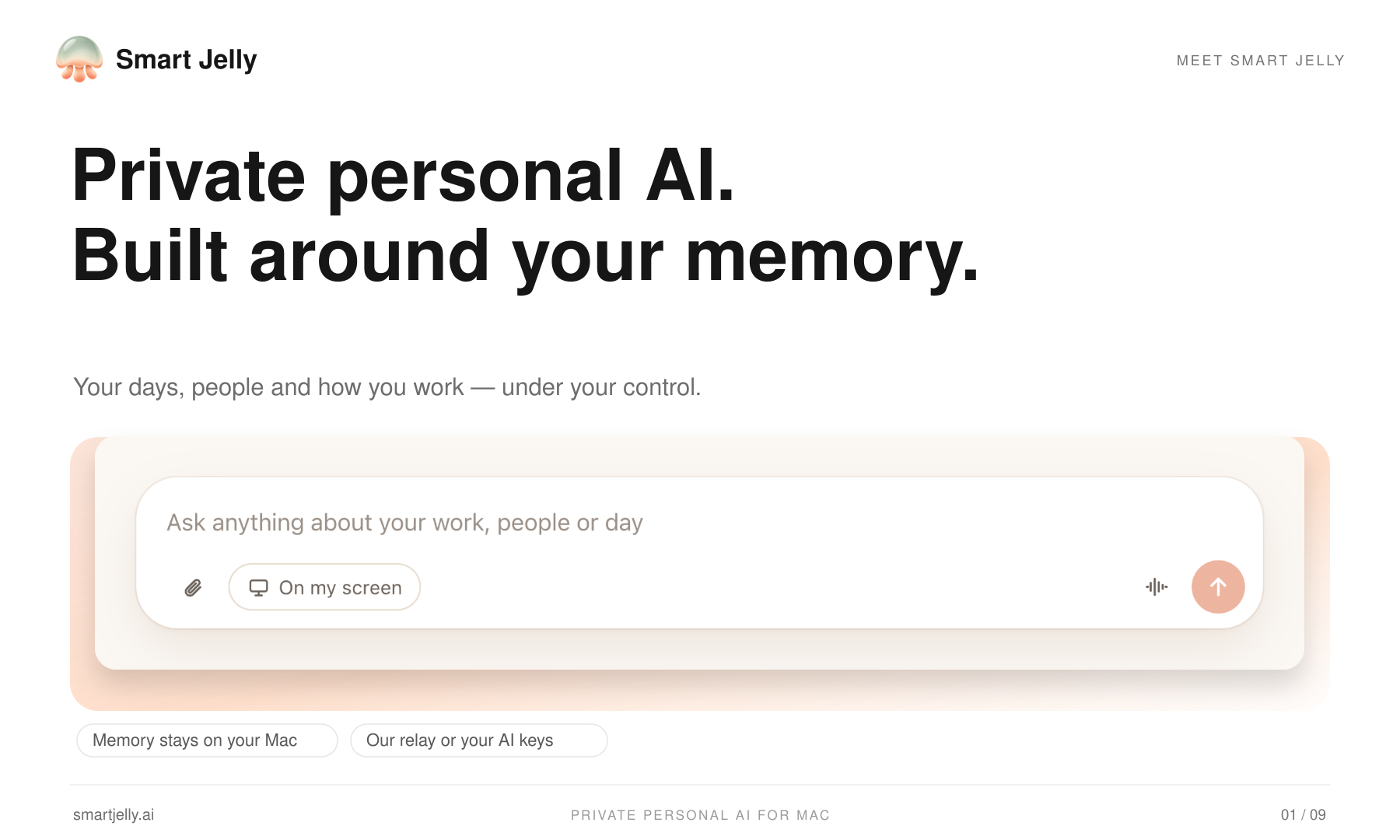
Most AI tools start every conversation from zero. They don't know who you are, what you promised on Tuesday, or that you prefer short replies. You can tell them, every time, or you can give them access to your whole life and hope for the best.
Smart Jelly takes a different route. It builds a memory of your work on your Mac, from only the apps you choose, and every feature in the app reads from that one memory. This post explains what the memory keeps, how it stays accurate, and where it lives.
Four kinds of memory
People remember in more than one way. You remember what happened yesterday, who your colleagues are, and how you like to work, and you use all three when someone asks you a question. Smart Jelly keeps the same four kinds.
Your days
The first kind is a record of what happened, and when. Each chat, call or stretch of work becomes an episode: the time, the people in it, a short account of what was said, and anything that was promised.

This is what answers questions like what did we decide in Tuesday's call?
People and facts
Some things outlive the conversation they came from. When Maya is called your manager in three different chats, that becomes a fact about Maya, and the three conversations are kept with it as evidence.

Facts cover the people you work with, the projects you're on, and the places and things that matter to you.
How you work
Over time, Smart Jelly notices your routines, your writing style and your preferences, such as short replies, no sign-off. A habit is only kept once there is evidence for it across several days, and you can confirm or remove each one.
Finding answers
The fourth part is retrieval: finding the right memories when you ask something, and checking the answer against them before it reaches you.
Every fact has a source
A memory you can't check is a memory you can't trust. So every fact, person and habit in Smart Jelly points back to the message or call it came from.
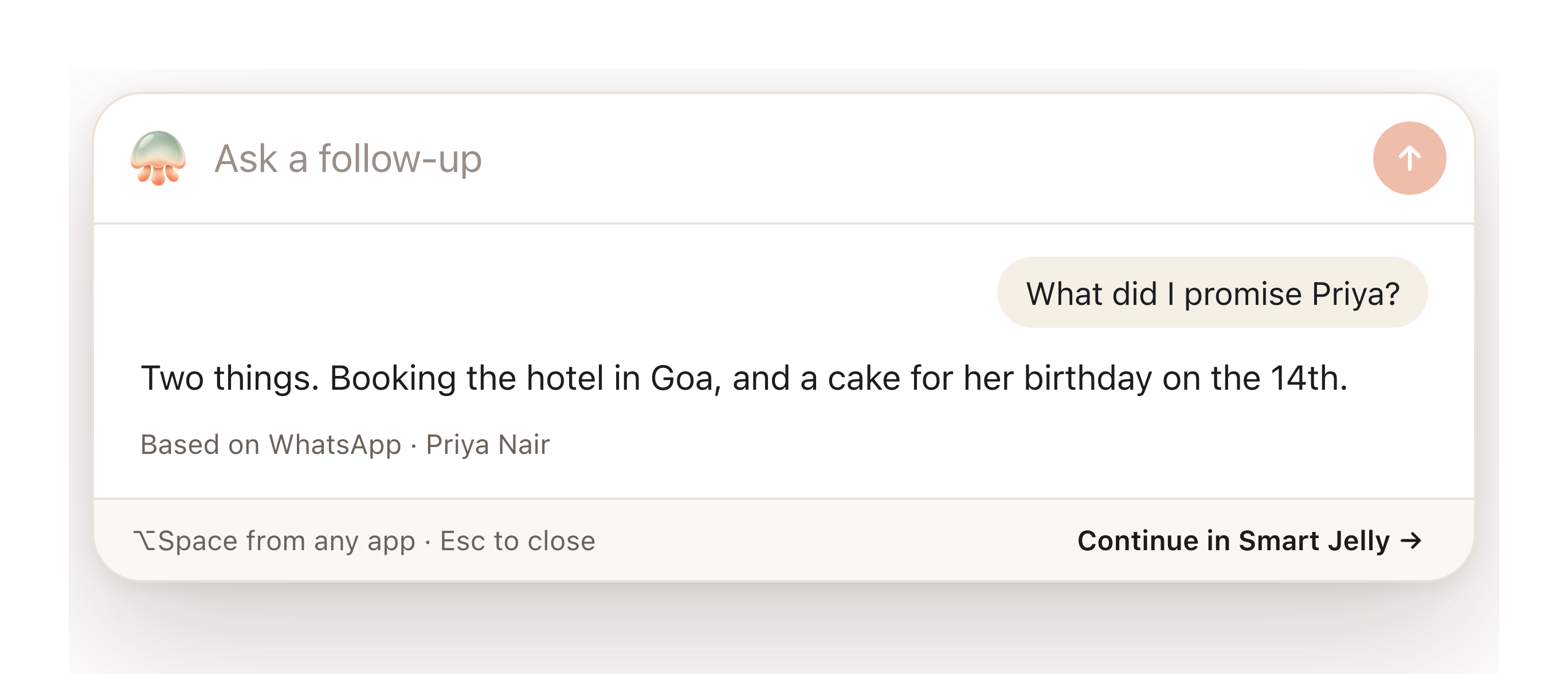
That has three practical effects:
- You can check any answer. Each one shows what it was based on.
- You can correct it. If a fact is wrong, fix it, and the correction stays.
- You can forget it. Forgetting a person or a conversation deletes it. It isn't hidden.
How well it remembers
We test the memory in public. On BEAM-100K, a public benchmark for long-term memory, Smart Jelly scores 87.6%, second of all published results. Every answer is published, so anyone can re-score it. The details are on our memory benchmarks page.
Where your memory lives
Your memory stays on your Mac, in an encrypted database only your Mac can open.
Smart Jelly reads only the apps and websites you turn on, and it reads their text the way screen readers do. It never records your screen. Banking, crypto and password apps are never read, even if you switch them on, and passwords, card numbers, one-time codes and keys are removed before anything is saved.
When a question needs reasoning, only the few lines it needs are sent, and you can see every request: the exact words, and why. You can use our relay, or your own AI key. We are also building Sting, an engine that runs this reasoning on the Mac itself. It's coming soon.
One memory, many uses
Ask Jelly, meeting predictions, live help during calls, meeting notes and Open Loops all work the same way: they read from this memory. A new feature doesn't need to learn about you from scratch. It starts with everything Smart Jelly already knows.
That is the idea behind Smart Jelly: AI that knows you, without asking you to give your life away to get it.
Smart Jelly is free to start, on any Mac with Apple silicon and macOS 14 or later. Download it here.